
Hey team,
The world is moving on, with or without American leadership. This week’s intelligence highlights a growing disconnect: diplomacy is fragmenting in Johannesburg, cyber warfare is escalating behind the scenes of climate talks, and military drills in Europe and the Pacific are setting a tempo for conflict. While markets are still cashing in on AI, the geopolitical ground is always moving.
Here are the critical developments you need to track.
BLUF
The G20 summit in South Africa went ahead without the United States, proving that other countries can make big decisions on their own. Climate talks in Brazil ended with a fight over fossil fuels, while military drills in Europe and the Pacific showed that big powers are getting ready for conflict. In the business world, the AI boom is still making money, but investors are getting nervous about the future.
Diplomacy
Content The biggest diplomatic news this week happened in Johannesburg, South Africa. The G20 summit took place there for the first time on African soil. The big surprise was that the United States decided not to go. President Trump boycotted the meeting because he disagreed with the agenda topics like climate change and fairness. He also has issues with some of South Africa's domestic policies.
Usually, a US boycott stops everything. This time it did not. The other 19 members quickly agreed on a final plan called the "Johannesburg Declaration." They focused on things like helping poor countries with debt and fighting hunger. This shows that the "Global South" (countries in Africa, Asia, and Latin America) is becoming powerful enough to lead without American help.
At the same time, the COP30 climate conference finished in Belém, Brazil. It was a tough meeting. A large group of countries wanted a written promise to stop using fossil fuels. However, oil-producing countries blocked this idea. They did agree to triple the money given to poor nations to help them handle climate disasters, but many people felt this was not enough.
Short-term Outlook The split between the US and the rest of the G20 is likely to cause trouble for the next month. The US is supposed to lead the group in 2026, but other countries might refuse to cooperate if the bad blood continues.
Information (Cyber & Influence)
There is a hidden war happening online. During the climate talks in Brazil, researchers found a massive "fake news" campaign. These attacks used bots and social media to spread lies saying that climate action is too expensive or does not work. This made it very hard for leaders to agree on real solutions.
In the corporate world, cyber criminals are getting more aggressive. A new report shows a rise in "Ransomware-as-a-Service." This means sophisticated hackers are selling their tools to ordinary criminals. Now, even small groups can launch attacks that lock up computer systems and demand money.
We also saw a big shift in how countries handle AI rules. The European Union is rushing to pass strict laws to control Artificial Intelligence before 2026. In contrast, the US is removing regulations to let companies grow faster. This creates a confusing situation where tech companies have to follow two completely different sets of rules.
Short-term Outlook Cyber attacks targeting holiday shopping and travel are almost certain to increase in December. Hackers know that IT teams are often understaffed during the holidays, making it a perfect time to strike.
Our industry award nominated, internationally certified Intelligence Analyst Certification Course will be opening for registrations in just six weeks! Join the waitlist so you don't miss out on Cohort Six of the IACC!
Military: Flexing Muscles
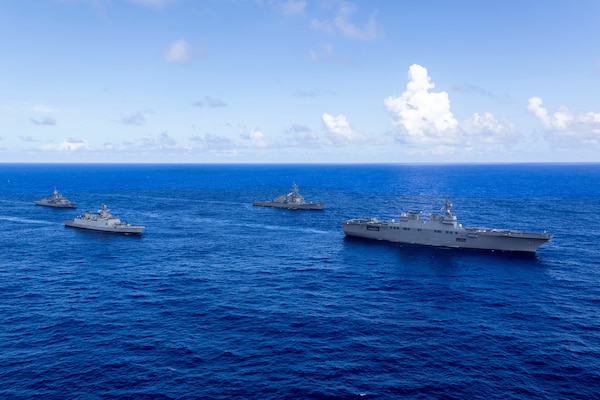
Armies around the world were very active this week. In the Pacific Ocean, the US Navy joined forces with Japan, India, and Australia for "Exercise Malabar" near Guam. They practiced hunting submarines and landing troops on beaches. This is a clear signal to China that these four nations are working as a team.
In Europe, Russia and Belarus held a large drill called "Zapad-2025." It took place right next to the border with NATO countries. The most worrying part was the announcement that Russia is permanently putting new "Oreshnik" missiles in Belarus. This gives Russia a new way to threaten European capitals.
South Africa also showed off its military strength. It held "Exercise Vuk’uhlome" to test its ability to fight a conventional war. Over 13,000 troops participated. This was a message to its neighbours that South Africa is still the main security power on the continent.
Short-term Outlook Tensions on the border between Belarus and Ukraine are likely to rise in the next few weeks following the Zapad exercises. There is a realistic possibility that Russia will keep some troops in Belarus even after the drills officially end.
Economic
Everyone on Wall Street was watching Nvidia this week. The company makes the chips that power Artificial Intelligence. They reported earnings of $57 billion, which is a massive number. This proves that the demand for AI is still huge.
However, the stock market reaction was strange. Nvidia's stock price actually dropped a little bit. This happened because investors are worried about the future. Big tech companies like Google and Meta are starting to build their own chips instead of buying from Nvidia. If they stop buying, Nvidia's profits could fall.
In Europe, gas prices are currently low because the weather has been mild. But this stability is fragile. Europe relies heavily on gas storage. If it gets very cold suddenly, those supplies will drain fast.
Short-term Outlook Stock markets will likely remain volatile through December as traders react to any news about AI spending. There is a significant chance of a market dip if other tech companies announce they are cutting back on their budgets.
Weather Events
For the first time in ten years, no hurricane hit the United States mainland during the entire hurricane season. There were plenty of big storms in the ocean, but a specific wind pattern pushed them all away from the coast at the last minute. This saved insurance companies billions of dollars.
Looking ahead, the global weather pattern is shifting to "La Niña."
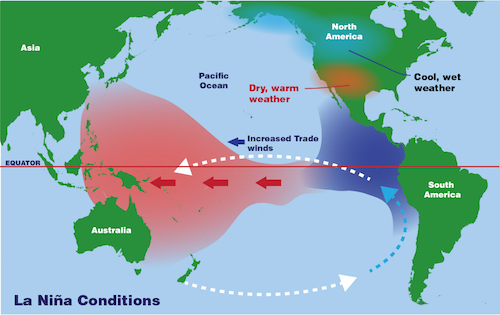
In Southern Africa, farmers are very worried. Forecasts predict a "midsummer drought" in late December. This is exactly when the maize (corn) crop needs rain the most. If the rain fails, millions of people could face food shortages next year.
Short-term Outlook It is highly likely that Southern Africa will experience heatwaves and dry conditions in the next four weeks. Farmers and governments need to prepare now for potential crop failures in January.
Responses