

How to Use Intelligence for Better Emergency Response
Feb 07, 2025Applying an Intelligence Approach to Emergencies
Emergencies disrupt daily life and demand quick, informed actions. Taking an intelligence-based approach means staying proactive, gathering and analyzing information, and maintaining communication with key contacts. You may need to take on responsibilities such as collecting real-time data, coordinating with others, and making strategic decisions under pressure. In some cases, you might need to guide others to safety and support broader response efforts.
Decision-makers, whether community leaders or emergency responders, rely on accurate, timely information to regain control and minimize risks. This guide follows the Prepare-React-Adapt model to help individuals approach emergencies with a structured and analytical mindset. By applying these principles, you enhance and support your overall preparedness efforts, ensuring better coordination, resource allocation, and decision-making in critical situations.
1. Prepare
Preparation happens before an emergency. It involves setting up intelligence structures, gathering data, and ensuring readiness.
-
Develop an Intelligence Framework: Define roles, responsibilities, and contingency plans for collecting and disseminating intelligence. Identify how information will be gathered and shared efficiently.
-
Enhance Situational Awareness:
-
Monitor Baseline Conditions: Establish an understanding of normal patterns in your environment to quickly detect anomalies.
-
Conduct an Environmental Scan: Assess your community for potential risks, including security concerns, emerging threats, and critical infrastructure vulnerabilities.
-
-
Maintain Critical Contact Networks: Keep updated lists of intelligence sources, key decision-makers, and trusted analysts for information exchange.
-
Refine Analytical Processes: Develop methods for processing information rapidly, identifying misinformation, and prioritizing intelligence requirements.
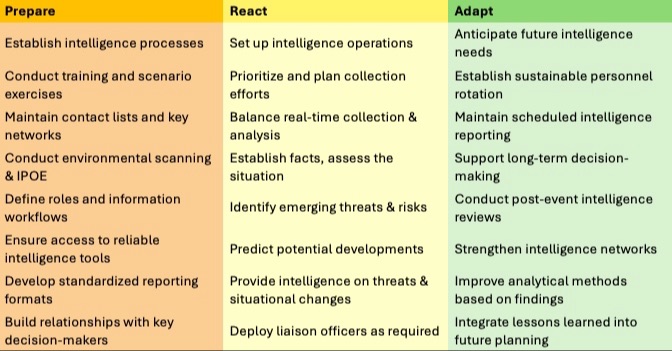
Prepare Phase Summary
-
Establish intelligence processes
-
Conduct training and scenario exercises
-
Maintain contact lists and key networks
-
Conduct environmental scanning and intelligence preparation
2. React
When an emergency unfolds, the focus shifts to collecting, analyzing, and disseminating intelligence in real-time.
-
Gather and Validate Information:
-
Monitor multiple sources, including official channels, open-source intelligence, and local networks.
-
Cross-check data points to confirm accuracy before sharing intelligence.
-
Identify disinformation and mitigate its spread.
-
-
Assess the Situation:
-
Determine the nature of the threat and its potential developments.
-
Identify gaps in intelligence and deploy collection efforts accordingly.
-
Develop a clear intelligence picture to inform decision-makers.
-
-
Disseminate Intelligence:
-
Provide timely updates to relevant stakeholders.
-
Adapt reporting formats to meet operational needs.
-
Ensure intelligence is actionable and aligned with decision-maker priorities.
-
React Phase Summary
-
Set up intelligence operations
-
Prioritize and plan collection efforts
-
Balance real-time collection and analysis
-
Establish facts, assess the situation, and predict developments
-
Provide intelligence on threats, movement constraints, and situational needs
-
Deploy liaison officers as required
3. Adapt
Once initial control is regained, intelligence operations must transition to sustained assessment and strategic planning.
-
Reevaluate Intelligence Priorities:
-
Identify emerging risks and intelligence gaps.
-
Adjust collection efforts based on evolving conditions.
-
Support decision-makers with forward-looking assessments.
-
-
Sustain Intelligence Operations:
-
Maintain structured reporting and briefings at regular intervals.
-
Continue monitoring external and internal developments.
-
Refine analytical methods based on post-event reviews.
-
-
Ensure Institutional Learning:
-
Conduct after-action reviews to document lessons learned.
-
Adjust intelligence processes based on findings.
-
Strengthen networks and preparedness for future incidents.
-
Adapt Phase Summary
-
Anticipate future intelligence needs and opportunities
-
Establish sustainable personnel rotation
-
Maintain scheduled intelligence reporting
-
Support long-term decision-making with forward-looking assessments
Key Takeaways
-
Apply an intelligence-based mindset to emergency preparedness and crisis response.
-
Preparation through structured intelligence gathering and analysis enhances decision-making.
-
During a crisis, accurate, timely intelligence is essential for effective response.
-
Intelligence must adapt to changing circumstances to maintain strategic advantage.
-
Continuous training and post-crisis evaluation improve resilience and preparedness.
Taking an intelligence-driven approach ensures that responses are data-informed, proactive, and effective when it matters most. Integrating intelligence into your broader preparedness efforts strengthens overall emergency response and enhances resilience in uncertain situations.