
Here at ALCON, we are slowly ramping up for the development of our Military Intelligence Operators Course - a flagship training programme giving you the tools and knowledge required to become a true military intelligence operator.
A key part of this role is understanding the adversary. What better way to prepare than to bring yourself up to sped with the People's Liberation Army? Let's go!
The People’s Liberation Army (PLA) sits at the centre of China’s state power. It serves the Chinese Communist Party first, and the state second, which shapes how it thinks about war, internal security, and political loyalty. Western militaries often talk about “civilian control of the military”; China’s model is party control, enforced through political commissars, party committees, and a command culture that rewards alignment with top leadership.
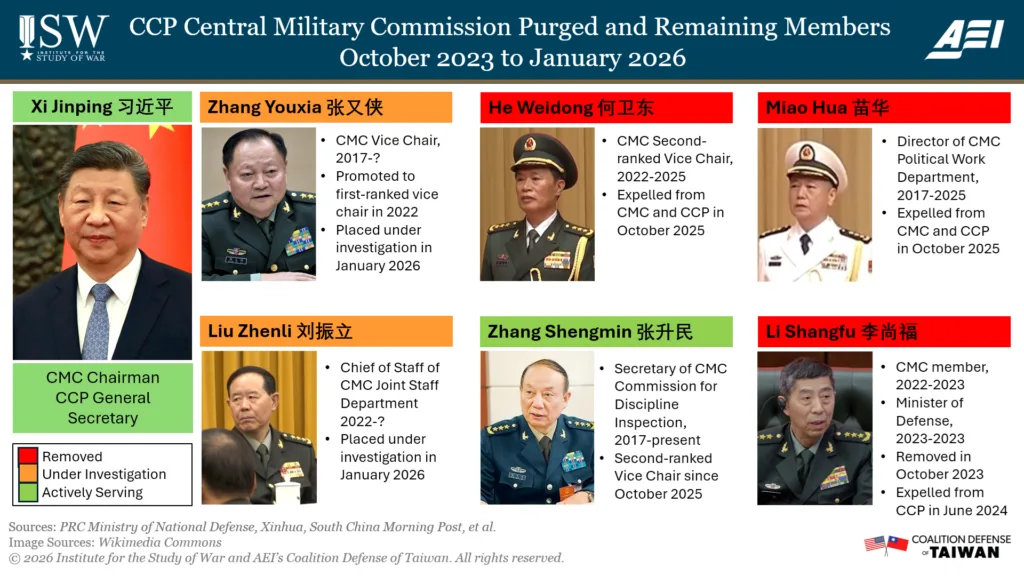
From ISW, showing key personnel both current and recently purged.
At the top of the system is the Central Military Commission, chaired by Xi Jinping. This body directs strategy, appoints senior commanders, and sets the tone for discipline and reform. Since 2015, Beijing has run repeated waves of restructuring aimed at improving joint operations, tightening political control, and shifting the force away from a ground-heavy legacy towards a military built for long-range precision strike, maritime pressure, and information advantage.
Organisationally, the PLA now presents itself through “four services and four arms”. The services are ground, naval, air, and rocket. The arms include newer functional groupings tied to space, cyber, information support, and joint logistics. A key 2024 change was the dissolution of the Strategic Support Force and the creation of the Information Support Force, shifting information-related functions closer to the centre of party control and wartime command.
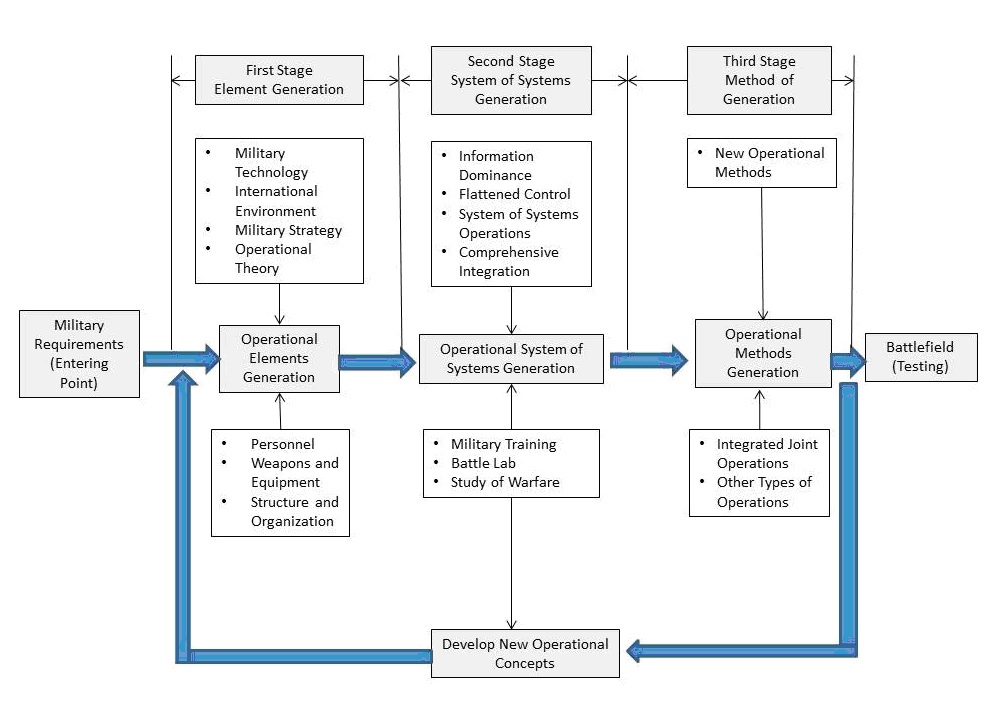
The PLA’s modernisation programme runs on clear timelines. US defence reporting assesses that the PLA is building capabilities to meet milestones around 2027, 2035, and 2049, with a strong focus on options for coercion or conflict in the Taiwan scenario. Those milestones shape procurement, training, and readiness messaging, and they also help Beijing measure whether reforms are translating into real warfighting ability.
In doctrine, the PLA views modern conflict as a contest between opposing systems: sensors, networks, command centres, logistics, and precision strike working together. Chinese writings describe “systems confrontation” and “systems destruction” approaches, where the goal is to break the opponent’s ability to see, decide, and coordinate rather than chase platform-versus-platform battles. In practical terms, this points towards early strikes on airbases, ports, satellites, data links, and command nodes, supported by electronic warfare and cyber activity.
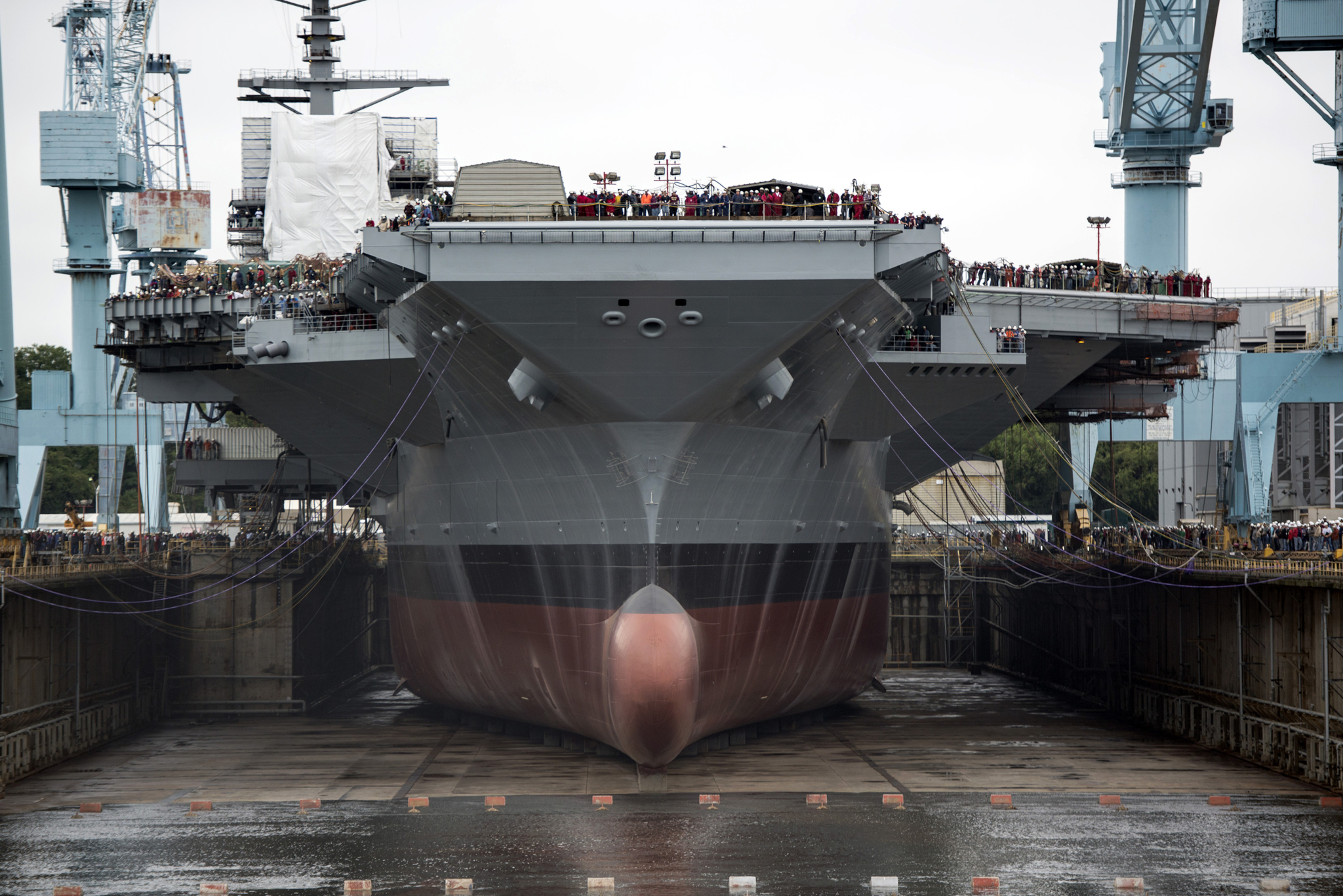
China eclipses US military ship building by an extremely wide margin
Capability growth is most visible at sea. The People’s Liberation Army Navy is widely described in official and congressional reporting as the world’s largest by number of battle force ships, backed by a huge shipbuilding base and an ecosystem that blends commercial and military production. This is important because fleet size enables presence, reach and power, even though combat capability depends on training, weapons, integration, and sustainment (to be tested operationally).
Strategic strike is nested within the People’s Liberation Army Rocket Force, which fields conventional and nuclear missile forces. Assessments highlight China’s expanding missile inventory, improving accuracy, and focus on holding regional bases, ports, and ships at risk, paired with air and maritime forces that could complicate reinforcement. This is super important to China’s anti-access approach in the Western Pacific.
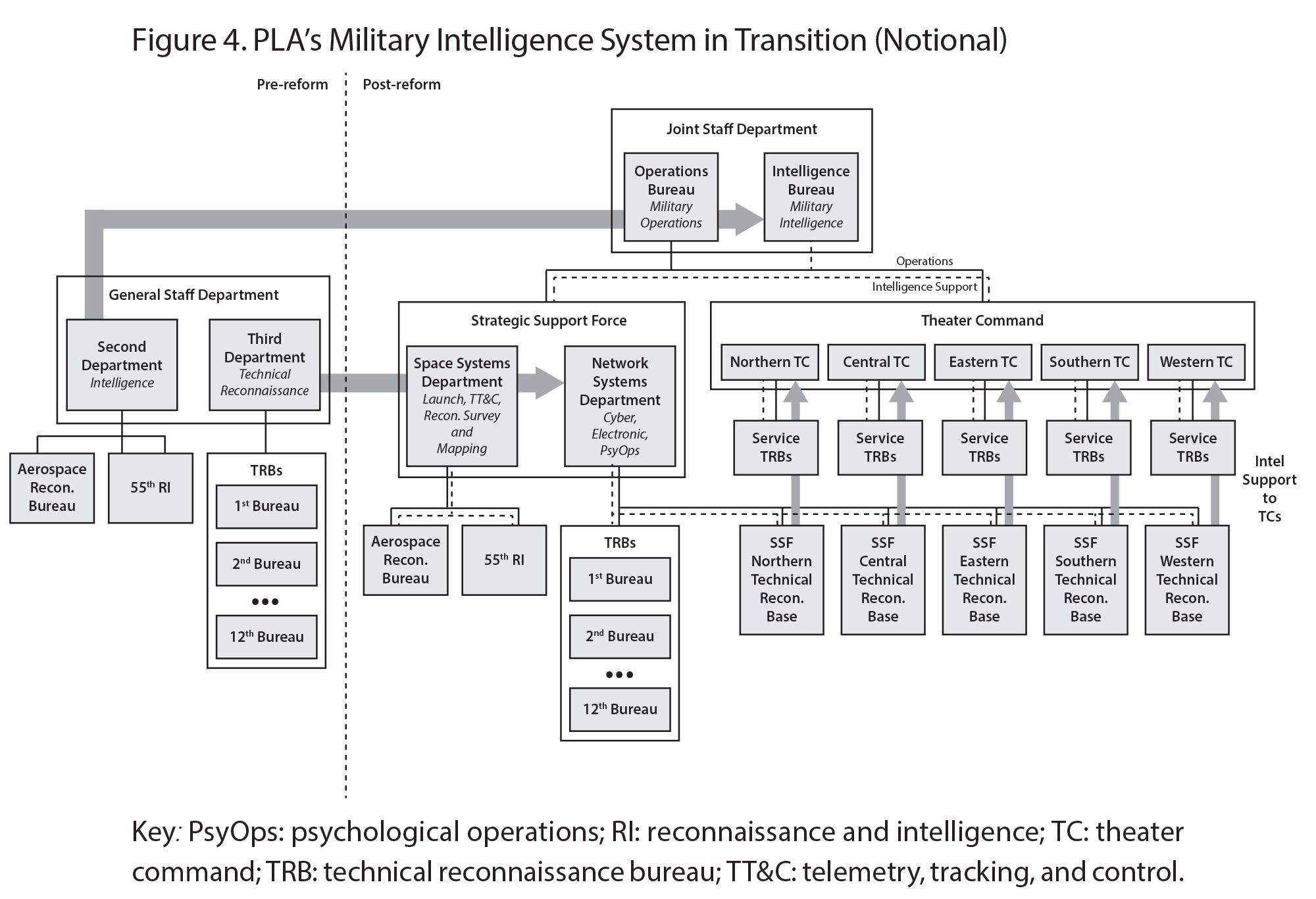
“Information dominance” now sits across everything: targeting, missile defence, air and maritime patrols, and joint command. The 2024 reforms and the rise of dedicated information formations signal that Beijing expects future conflict to be won by whoever controls data flow and decision speed. Security analysis also points to a steady move towards “intelligentised” concepts, where automation and AI support planning, sensing, and swarm tactics, even if technical limits still apply in real combat conditions.
Tips for Analysts
The PLA also has persistent weaknesses that matter for analysts. It has limited recent combat experience especially when compared to the West, it continues to work through joint command and realistic training issues, and it has faced repeated corruption problems that Beijing treats as a readiness threat as well as a political threat. Many reforms aim to fix these issues, so good PLA assessment monitor what changes on paper, what appears in exercises, and what shows up in logistics, mobilisation, and movement within the ranks of top brass.
A useful way to watch the PLA in 2026 is to focus on indicators of real operational maturity: large joint exercises with complex objectives, sustained deployments far from home waters, tighter integration of rockets, air, naval and information forces, and evidence that new structures have improved command speed under stress. The big question we are always asking ourselves: whether the PLA can convert rapid material growth into reliable joint operations in a high-threat combat environment, especially around Taiwan...

Responses