Hey team,
Plenty of things to discuss globally, but this special edition stays on Iran. The currency has crashed, protests are running across the country, the Revolutionary Guards are talking up their missile strength, and the nuclear and sanctions tracks are back in the spotlight.
Here is what is happening now and what to watch in the coming weeks.
BLUF
- Iran enters 2026 facing nationwide protests sparked by a currency collapse and the bankruptcy of Ayandeh Bank, one of the country’s largest private lenders, exposing deep rot in the banking sector and years of mismanagement under heavy sanctions. (The Wall Street Journal)
- The security forces and Basij units have responded with intense repression, with reports of hundreds and possibly thousands of deaths, mass arrests, and Iranians fleeing across land borders into Turkey. (Al Jazeera)
- The Revolutionary Guards say their missile stocks and production capacity now exceed pre-war levels after a 12-day conflict with Israel in 2025, and the military is on high alert as Washington warns of “strong action” over the crackdown. (Reuters)
- UN “snapback” nuclear sanctions have been reimposed, the IAEA is demanding access to damaged and undeclared sites, and Iran’s economy is sliding under inflation above 40 percent, subsidy cuts, and accelerating capital flight. (AP News)

Enrollments are currently open for the Intelligence Analyst Certification Course. Understand and anticipate an uncertain world and become a certified analyst today - trained to international standards.
Diplomacy
UN nuclear sanctions were reactivated in late 2025 via the JCPOA snapback mechanism, refreezing Iranian assets, restricting arms transfers, and tightening limits on missile work at a time when the economy was already strained. These measures came after US and Israeli strikes on parts of Iran’s nuclear programme and a short but intense war with Israel, which pulled Tehran into more direct confrontation with Western states and regional rivals.
As protests have spread since late December 2025, Washington has openly encouraged Iranians to continue demonstrating and has warned of strong consequences for Tehran if the crackdown escalates, while urging US citizens to leave Iran via Turkey or Armenia. Iranian officials accuse the United States and Israel of orchestrating “political destabilisation” and have warned neighbouring countries that host US troops that they could face retaliation if foreign intervention grows.
European governments and policy institutes are framing Iran’s situation as a structural crisis, not a passing wave of unrest, and are debating how hard to lean on sanctions versus engagement, while staying wary of steps that might slide into regime change by force.
Short-term outlook (Diplomacy)
Over the next month, it is almost certain that Iran will remain under heavy diplomatic pressure, with no realistic prospect of sanctions relief or rapid nuclear talks. Statements from Western and regional capitals criticising the crackdown and backing protesters are likely to continue, while Russia and China provide cover at the UN without committing major economic lifelines. The creation of a formal contact group or mediation track is possible but, in this timeframe, any such initiative is likely to stay at the level of exploratory consultations.
Information and Influence
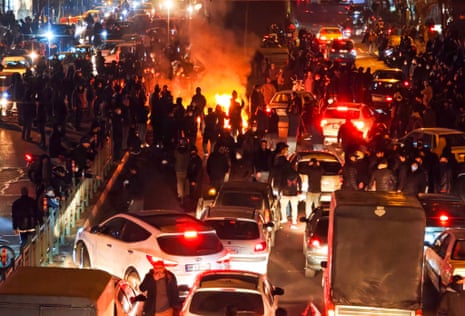
Protests that began over the rial’s collapse and surging prices in December have widened into open calls for the end of clerical rule, drawing in students, workers, merchants, and parts of the urban middle class that had previously stayed on the sidelines. Analysts link the immediate trigger to Ayandeh Bank’s failure, which exposed an estimated 5 billion dollars in bad loans and insider deals and forced regulators to merge the lender into state-owned Bank Melli, reinforcing public anger at corruption and elite privilege.
Authorities have responded with what outside observers describe as unprecedented brutality for the Islamic Republic’s history: live fire against crowds, mass detentions, and sweeps through neighbourhoods tied to earlier protest movements. Estimates for protester deaths vary widely, from hundreds to several thousand, reflecting both the scale of violence and the regime’s control of information. The state has imposed rolling internet shutdowns and social media blocks, while state media highlight funerals of security personnel and frame events as foreign-inspired riots.
Despite these controls, videos and testimonies continue to move out through VPNs, satellite links and the diaspora, with private satellite providers offering free or discounted access into Iran. Activists abroad are organising fundraising, translation, and advocacy campaigns aimed at keeping global attention on protest hubs inside the country. At the same time, Tehran’s narrative that the unrest is a Western-backed plot still resonates with some supporters and gives the regime a justification for harsh security measures.
Short-term outlook (Information)
In the next month, sustained protest activity somewhere in Iran is almost certain, although intensity will likely fluctuate from city to city as security forces concentrate and fatigue sets in. Further internet disruptions, arrests of journalists and activists, and pressure on families of protesters are very likely as the regime tries to choke off organising networks. There is a realistic possibility of more coordinated online campaigns by both diaspora groups and pro-regime actors, including hack-and-leak operations and deepened information warfare with the US and Israel.

Military
Iran’s security apparatus is posturing readiness for confrontation. The Islamic Revolutionary Guard Corps Aerospace Force says it has increased missile stockpiles and restored production capacity beyond pre-war levels after a 12-day conflict with Israel in 2025, and senior commanders now speak of “full battle readiness”. The regular army and IRGC units are deployed in major cities to suppress protests, while elite formations stay postured for external contingencies.
Iran’s leadership claims that the United States is “manufacturing a pretext” for intervention and has warned that any attack from US forces or regional bases would be met with strikes on those sites, raising tensions for countries that host US troops. Western think-tank assessments note that while Iran’s conventional forces remain outmatched, its ballistic missiles, cruise missiles, drones and network of regional partners still give Tehran capacity to hit US and allied targets across the region, from the Gulf to the Levant and possibly on shipping routes.
On the nuclear track, the IAEA’s most recent reports complain that Iran is in breach of its safeguards obligations, holding near-weapons-grade uranium and restricting inspector access to multiple locations, including facilities damaged in the 2025 strikes. Senior Iranian figures have said that Tehran might consider developing nuclear weapons if attacked directly by the US or Israel, a stance that sits in the background of current brinkmanship.
Short-term outlook (Military)
Over the coming month, it is highly likely that Iran’s armed forces and IRGC will stay on elevated alert, using drills, missile tests or media statements to reinforce deterrence. Limited incidents involving Iranian-aligned groups in Iraq, Syria, Lebanon or the Gulf are possible, especially if the protest crackdown intensifies and Tehran seeks external distractions, but deliberate large-scale strikes on US or Israeli territory remain unlikely in this short window. The risk of miscalculation, however, is real, particularly if a protest-related incident coincides with a security scare around nuclear sites or missile deployments.
Enroll in the Intelligence Analyst Certification Course - registrations close 23rd January 2026!
Economic
Iran’s economic crisis is now severe and visible. The rial lost nearly half its value in 2025 and then plunged further after snapback sanctions and the Ayandeh Bank collapse, with inflation above 40 percent and basic goods out of reach for many households. Ayandeh’s bankruptcy revealed around 5 billion dollars in bad debts tied to politically connected borrowers, and regulators moved in October 2025 to revoke its licence and fold deposits into Bank Melli, confirming fears that other banks may carry similar risks.
In parallel, the government has rolled out austerity measures, including cuts of roughly 10 billion dollars in subsidies, removal of preferential import exchange rates, and a new fuel pricing tier that sharply raised petrol costs. These moves were intended to stabilise finances under tighter sanctions and declining oil revenue but instead deepened public anger, as many Iranians saw elites retaining access to cheap foreign currency and patronage while ordinary incomes eroded.
Capital flight has increased, with estimates that 10 to 20 billion dollars left Iran last year, and sanctions have forced Tehran to rely on a “shadow fleet” to move oil, with access to dollars through Iraqi banks curtailed. The crisis is spilling over borders; Najaf in Iraq reports steep drops in Iranian pilgrims and hotel closures as Iranians can no longer afford religious travel, undercutting one of the few areas where Iranian spending had boosted regional economies.
Short-term outlook (Economic)
In the next month, it is almost certain that ordinary Iranians will see further pressure on living standards, with inflation, currency weakness and subsidy changes feeding into food, fuel and rent costs. Bank sector stress is likely to continue, and another institution revealing large losses or liquidity problems is a realistic possibility, even if the state tries to manage this quietly. Regionally, reduced Iranian spending abroad, higher perceived risk, and caution among traders and shipping operators are likely to persist, although a sudden, large shift in global oil supply from Iran alone remains unlikely on this timescale.
Closing
That is the current picture on Iran: a stressed state facing a broad uprising, an economy in freefall, and a security posture geared for confrontation while the nuclear file heats up again.
What are you watching in this crisis? Let us know in the comments!
Stay safe,
ALCON.
Responses