

The point
Most evidence fits more than one explanation, so gathering support for your best guess feels like progress while it proves almost nothing. Analysis of Competing Hypotheses fixes that by making you test every explanation at once and keep only the ones that survive. The habit to build is to look for the evidence that would rule your favourite answer out.
The problem, plainly
Put an analyst under time pressure and a familiar pattern appears. They settle on the explanation that looks most likely, then work through the incoming reporting for things that fit it. Each new item that fits feels like the picture getting clearer. It is not. A troop build-up near a border fits an invasion. It also fits a scheduled exercise, a coercive bluff, and a routine rotation. Evidence that is consistent with every explanation cannot tell them apart, yet it still lands as confirmation. This is confirmation bias, and it is one of the most stubborn faults in the trade.
Where it comes from
Richards Heuer spent decades as a CIA analyst and methodologist. In 1999 the CIA published his book Psychology of Intelligence Analysis, and Chapter 8 set out Analysis of Competing Hypotheses, or ACH. Heuer's argument was simple and uncomfortable. The mind is not a blank slate that weighs every explanation evenly. It reaches for one story early and then defends it. A method has to work against that pull rather than hope it away.
ACH does that with a matrix. You list the plausible hypotheses across the top and the evidence down the side. Then you go across the grid one piece of evidence at a time and mark, for each hypothesis, whether that evidence is consistent or inconsistent with it. Working by evidence rather than by hypothesis is the point. It stops you bending the whole file toward the answer you already prefer.
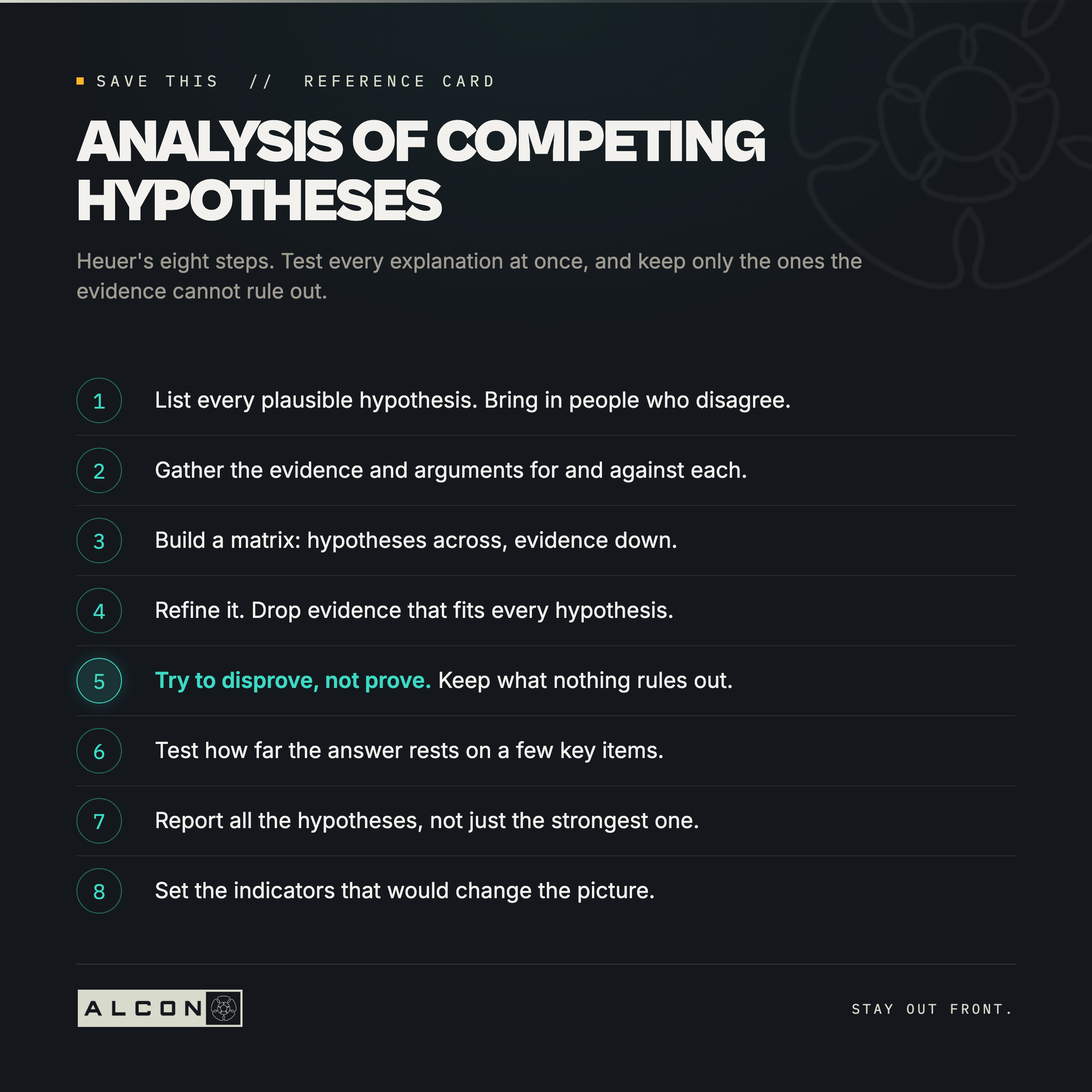
Save this one. Heuer's eight steps, with the move that does the work highlighted.
The fix
The move that changes the outcome sits in the middle of the process. You do not score a hypothesis by counting the evidence that fits it. You keep the hypotheses that no evidence rules out. Heuer called the evidence that does this work "diagnostic". A diagnostic item is consistent with some hypotheses and inconsistent with others, so it separates them. An item that fits everything has no diagnostic value, however strong it looks. One piece of inconsistent evidence is worth more than ten pieces that fit every column.
That inversion, disprove rather than prove, is the whole technique in one line. It also changes how you report. Because you have carried every hypothesis to the end, you can tell the decision maker not just your leading judgement but which alternatives you considered and why you set them aside.
The trade-off
ACH is not free. A full matrix takes time, so save it for the assessments that matter rather than every daily task. It is also only as good as the hypotheses you begin with. If the real answer is never on the list, no amount of matrix work will surface it. Deception makes this worse, because a capable adversary will feed you evidence that fits the story they want you to hold. The defence is to widen the hypothesis set early, and to bring in someone who disagrees with you before you build the grid, not after.
Do this next
On your next real assessment, write down at least three explanations, including one you would rather were not true. For your preferred answer, name the single piece of evidence that would rule it out, then go and look for it. If you cannot find it, your confidence can rise for a reason you can defend to someone else. If you do find it, you have just avoided being wrong in public.

This is the kind of tradecraft the Intelligence Analyst Certification Course teaches, step by step. If these editions are useful to you, the course is the next step.



Responses