
ICOD 30 September 2026.
Bottom Line Up Front
The US and Iran are in a stand-off: each side keeps its restrictions in place while talks go on. US warships stop ships entering or leaving Iranian ports, and Iran keeps the Strait of Hormuz mostly closed. A deal to reopen the strait in October is unlikely. The main alternative is a new exchange of fire, and one possible trigger is a clash at sea.
Introduction
The war began on 28 February, when US and Israeli strikes killed Iran's Supreme Leader, Ali Khamenei. Mojtaba Khamenei replaced him in March. Iran closed the Strait of Hormuz, the narrow sea route out of the Gulf, though sources disagree on the date.
On 13 April the US began its naval blockade of Iranian ports.
The sides agreed to stop fighting in April and signed an agreement on 17 June. It collapsed on 8 July, and fighting flared again in early September. This edition covers the risk of escalation, meaning wider or heavier fighting, from 1 to 30 October.
The pause and the talks
One daily tracker records no announced US strikes on Iran since about 7 September, and no reported Iranian ballistic missile launches since about 9 September. On 25 September Iran offered to reopen Hormuz within seven days. In return the US would lift the blockade and oil sanctions, release frozen funds and end fighting on all fronts, including Lebanon. Nuclear talks would follow.
Trump rejected the plan on 26 September. He has said he expects "a deal right after the election", meaning after the US midterm elections on 3 November. Qatari officials met Iran's foreign minister, Abbas Araghchi, in New York on 28 September. Araghchi says they met again on 29 September.
An agreement that reopens the strait during October, in full or in part, is unlikely. Iran wants the blockade lifted before nuclear talks. An unnamed US official says the nuclear programme must be addressed first. Neither side has publicly offered to change that order.
Talks through Qatar are likely to go on without a signed text. As Iran's oil income falls, it is a realistic possibility that Iran threatens regional shipping or Gulf oil sites to push for the blockade to end. Iran's parliament speaker said on 29 September that "in a region where we cannot sell oil, no one will sell oil".
The Strait of Hormuz
Shipping incident reports describe at least five merchant ships hit near the strait in September. On 23 September an Indian sailor was killed on the cargo ship Cape Dao. A late third-party report says the Kuwaiti tanker Al Funtas caught fire after a hit on 28 September. No government has named the attackers.
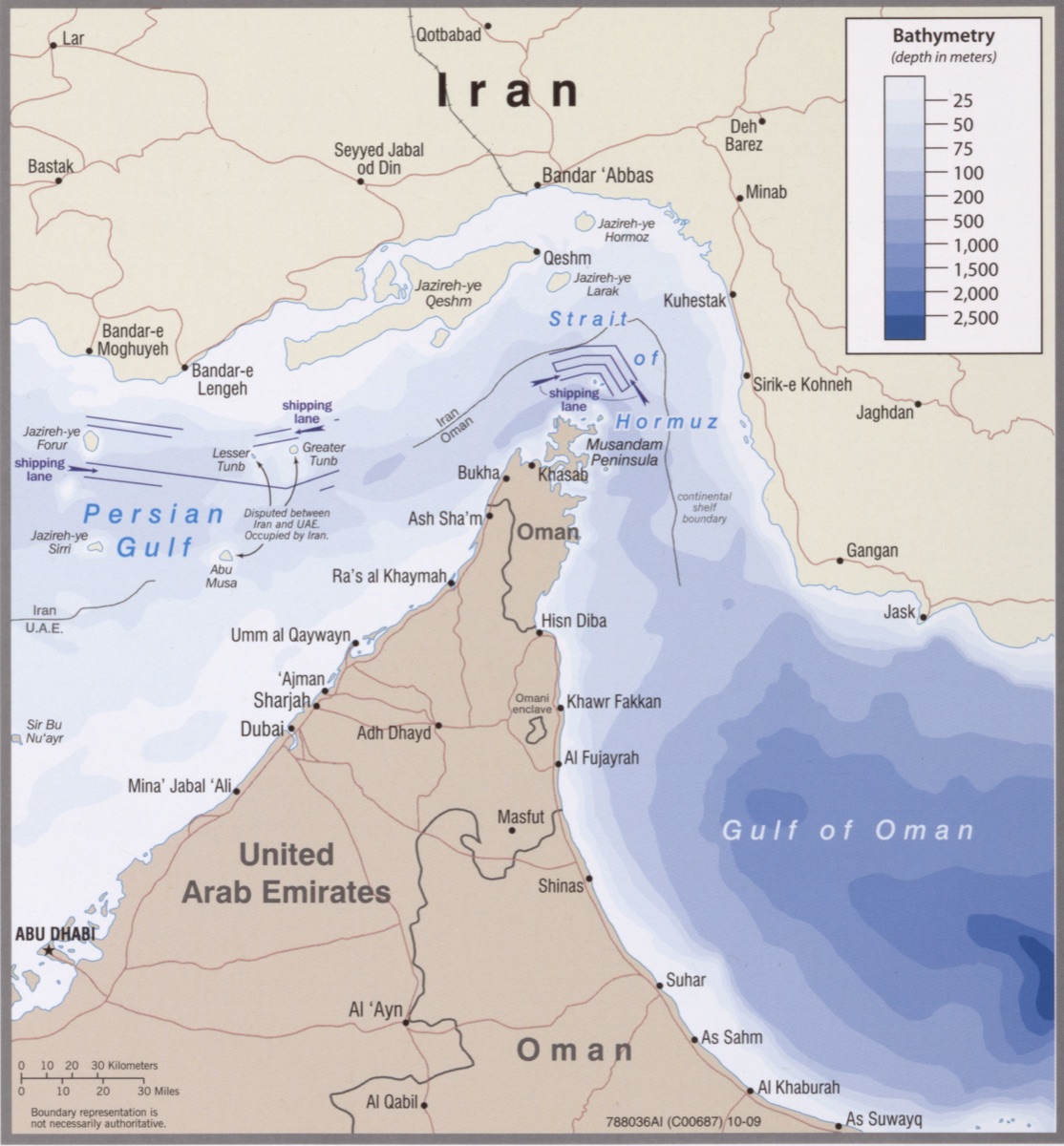
The Strait of Hormuz and its shipping lanes. Map: US Central Intelligence Agency, October 2009. Public domain.
On 14 September an Iranian cruise missile hit a vessel carrying US Marines, and eight were hurt. All accounts of this come from one NBC News report, and the Pentagon did not announce it.
Ship trackers count traffic in different ways. Windward counted 55 ship passages in the week to 23 September, against about 910 a week before the war.
More merchant ships are highly likely to be hit in or near the strait in October. The US blockade is likely to stay in place all month, which keeps Iran's reason to put pressure on shipping. It is a realistic possibility that Iran's parliament passes a law letting Iran hold ships that break its rules and take a fifth of the goods they carry. The Guardian Council, the Iranian body that must approve new laws, would then have to approve it. If the law is passed, approved and enforced, a seizure under it is a realistic possibility.
Direct military escalation
In the fighting from 1 to 9 September, US officials said Iran fired ballistic missiles at a US aircraft carrier and a destroyer. Jordan's army said it destroyed 18 of 20 Iranian missiles fired at a base in Jordan. CENTCOM, the US military command for the Middle East, said it struck Iranian air defences and disabled Iranian tankers.
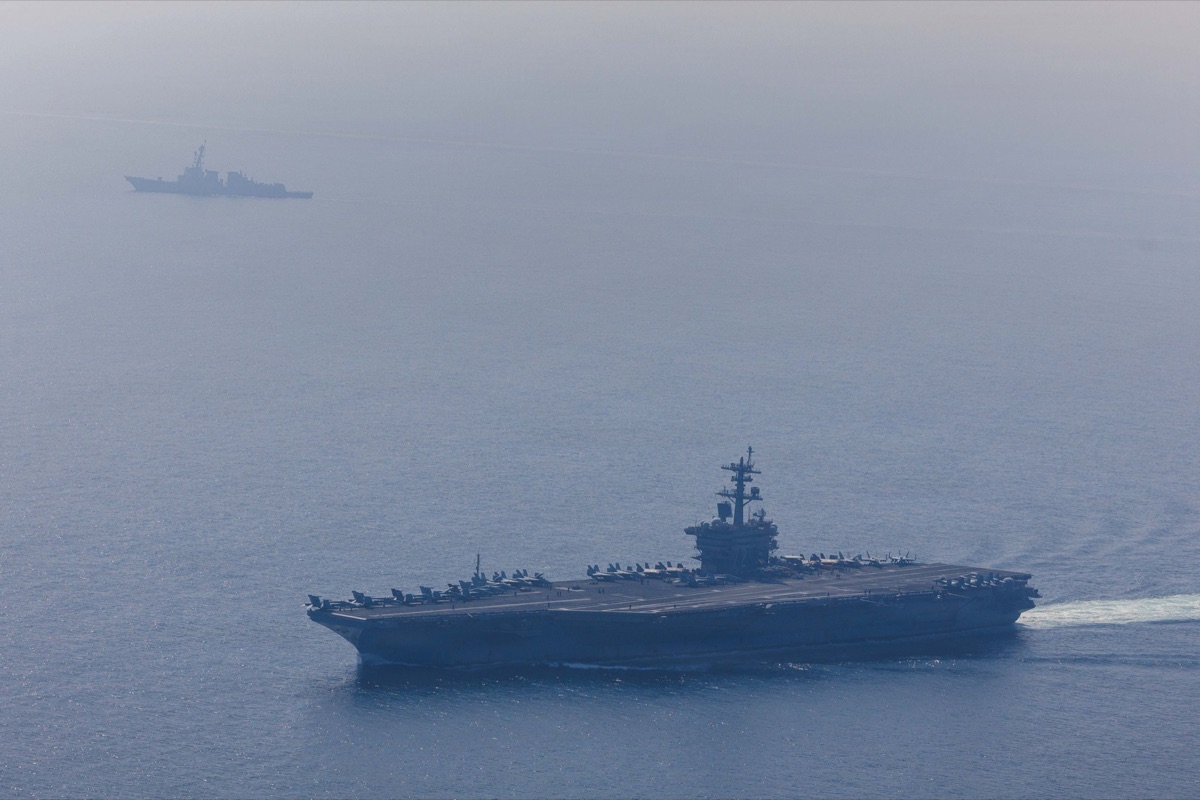
The aircraft carrier USS Abraham Lincoln and the destroyer USS Frank E. Petersen Jr. in the Arabian Sea on 6 February 2026, three weeks before the war began. Photo: US Navy, Mass Communication Specialist 1st Class Jesse Monford. Public domain.
On 27 September Trump said of new strikes, "I am always thinking about it." The Wall Street Journal reported that he expects strikes to resume after the midterms.
A new exchange of fire between US and Iranian forces in October is a realistic possibility. The timing rests partly on that one newspaper report, which cites unnamed officials.
If fighting resumes, Iranian missiles at Gulf states or Jordan are likely, as on 9 September. A campaign with strikes on three or more days in a week is unlikely.
An Israeli strike on Iran in October is a realistic possibility, and more so if US-Iran fighting resumes. No Israeli strike on Iran was found for September. Israel's defence minister has promised a powerful response to any Iranian attack on Israel, but has not said Israel would act only then.
The proxy fronts
A proxy is an armed group that fights for the interests of another country. On 10 and 11 September the Houthis, an Iran-backed armed group in Yemen, took Yemen's whole Red Sea coast. On 14 September the Houthis said they fired dozens of missiles and drones at a Saudi air base. Saudi Arabia reported shooting down Houthi attacks on 19 and 26 September, and its jets struck the Yemeni city of Taiz on 27 September.
Fighting between the Houthis and Saudi Arabia is likely to continue through October. The reported numbers of people killed or hurt at Taiz come only from Houthi sources.
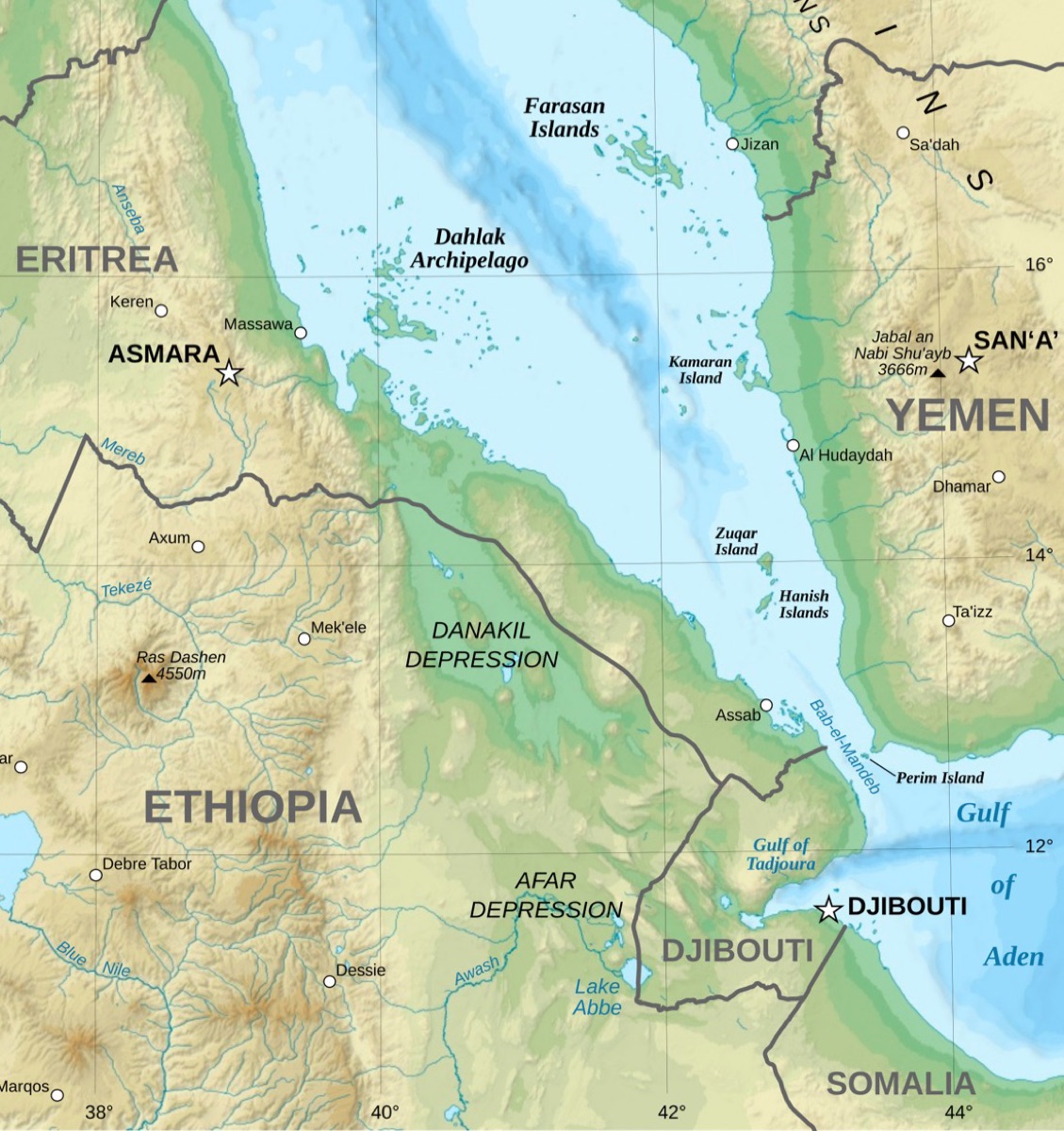
The southern Red Sea, Yemen's coast and the Bab-el-Mandeb strait. Map: Eric Gaba (Wikimedia Commons user Sting), CC BY-SA 4.0, cropped.
Pressure on Saudi Arabia also comes from Iraq. On 10 September drones launched from Iraq hit Saudi Arabia's main oil pipeline. More such launches at Gulf oil sites are a realistic possibility.
An attack by Iraqi armed groups on US forces is unlikely. Iraq's prime minister is the only source for a promise of 90 days without such attacks, to run after US troops leave. The date set for them to leave was 29 September.
Two other fronts could widen the fighting, though neither changes the Houthi-Saudi judgement. In Lebanon, the armed group Hezbollah and Israel trade drone and air strikes at a low level. A wider war there in October is unlikely. Iranian strikes on camps in northern Iraq linked to Kurdish groups that oppose Iran's government are a realistic possibility. Only the Washington Kurdish Institute and a Kurdish party official report the September strikes.
Flow-on effects
The price of Brent crude oil, used to compare oil prices worldwide, ranged from about US$103 to US$109 a barrel in the last week of September. Brent is likely to average above US$95 in October. A deal that restores oil shipments is likely to lower prices, because more oil would reach buyers.
Bloomberg reported that on 28 September QatarEnergy extended its force majeure notices to buyers in Pakistan, Bangladesh and India through November. Force majeure is part of a written agreement that can excuse missed deliveries in set circumstances. Reuters reported at least five loaded Qatar-linked gas ships leaving the Gulf from mid-September. QatarEnergy says two gas production units have been out since March and need three to five years of repair.
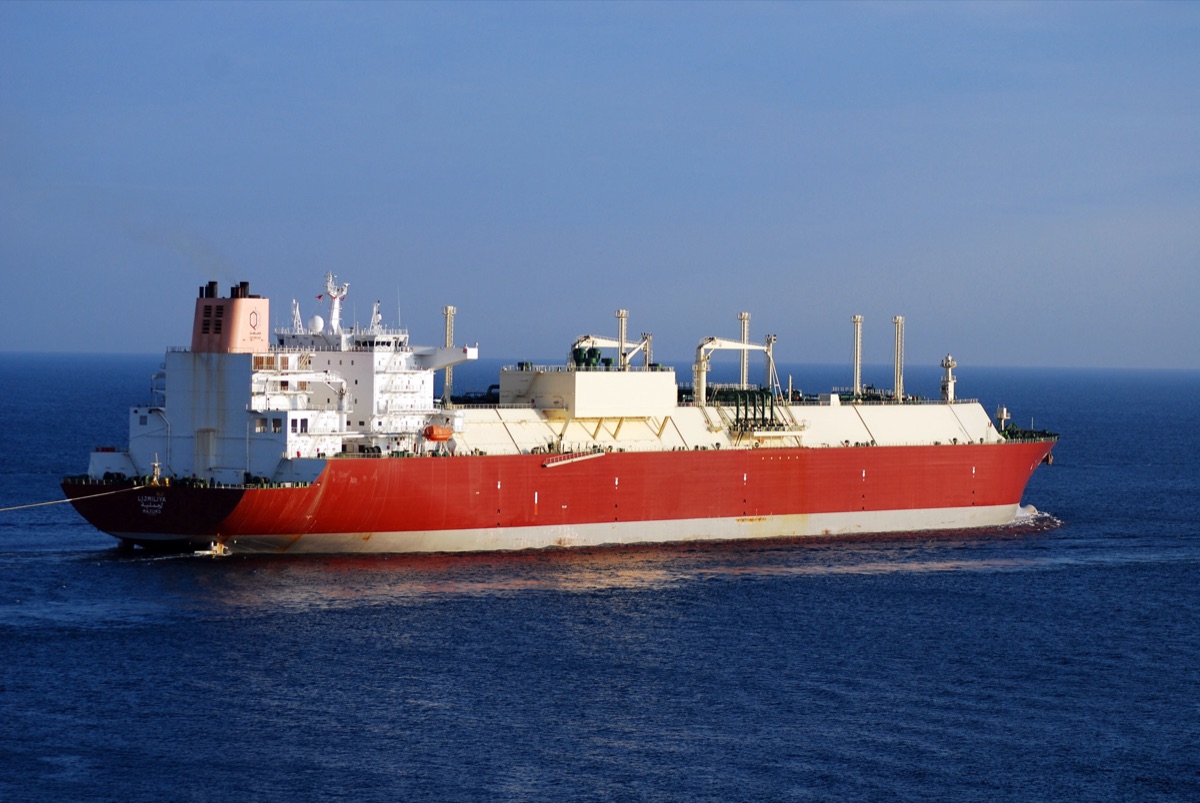
The Qatari liquefied natural gas carrier Lijmiliya at sea in May 2010. Photo: devopstom via Wikimedia Commons, CC BY-SA 2.0.
The amount of gas Qatar can sell abroad is likely to stay below its pre-war level through October, whatever happens in Hormuz. Too little fuel during winter in Pakistan and Bangladesh is a realistic possibility, depending on whether buyers find other supplies.
Many ships already sail around Africa to avoid the Red Sea. With danger in both seaways, further delivery delays and higher shipping costs are a realistic possibility, though no October cost figures exist.
China has been a major buyer of Iranian oil. Kpler, a ship-tracking firm, reported that China bought far less Iranian oil in August to date than its 2025 rate. On 16 September China's foreign minister urged all parties to reopen the strait. China is likely to keep pressing Iran to reopen it.
Iran at home
AP reported that on 29 September one US dollar cost more than 2.5 million rials, the weakest rate yet for Iran's currency. Mojtaba Khamenei has not been seen in public since March.
Iran's leadership is likely to stay in place through October, though there is no independent evidence of the Supreme Leader's health. A further record low for the rial is likely.
Large protests across Iran, like those of 2022, are unlikely in October. No nationwide protests were reported in September, and a 16 September strike was limited to Kurdish towns. Reporting from inside Iran is thin and comes mostly from groups that oppose Iran's government.
The next 30 days
The most likely path is a continued stand-off, with the blockade in place and talks going on. One newspaper report, citing unnamed officials, says Trump expects strikes to resume after the midterms. Ships keep being hit, and the attackers stay publicly unidentified, as in September's documented cases.
The main alternative is an exchange of fire that starts at sea, for example after a deadly hit on a ship carrying US forces. A seizure under Iran's proposed law, once passed and approved, could also start it. An Israeli strike is a separate route.
Indicators 1, 2 and 4 would show that fighting has resumed. Only indicator 4 shows it starting at sea. Indicators 3 and 5 are warnings that raise the risk.
| Indicator | Where it shows up | Why it matters |
|---|---|---|
| 1. CENTCOM announces strikes on Iranian territory | CENTCOM statements | Ends the reported pause in announced strikes |
| 2. Iran fires ballistic missiles at a Gulf state, Jordan or a US warship | Gulf and Jordanian defence statements | Ends the reported pause in ballistic missile launches |
| 3. US troops are killed by Iranian fire | Pentagon announcements | Adds pressure on the US to respond before the midterms |
| 4. Iran seizes a ship under the new law, and the US responds with armed force | Notices from UK Maritime Trade Operations (UKMTO), a UK service that warns ships of danger | A seizure alone, even with shots fired, stays short of a US-Iran exchange |
| 5. The US declares the talks over, or Qatar stops its help with the talks | White House; Qatar foreign ministry | Could make an incident harder to settle through talks |
The next update follows the first week of November, after the US midterm elections.

Assessments like this one are built with the methods the Intelligence Analyst Certification Course teaches, step by step. If these editions are useful to you, the course is the next step.

Responses