
Bottom Line Up Front
On 28 February 2026, the United States and Israel launched a coordinated military campaign against Iran, designated Operation Epic Fury by the U.S. and Operation Roaring Lion by Israel. The strikes targeted Iranian leadership, nuclear infrastructure, missile production sites, and naval forces. Supreme Leader Ali Khamenei was killed in the opening phase, along with more than 40 senior officials. Iran retaliated with missile and drone strikes across the Middle East, hitting U.S. bases and Gulf state territory under Operation True Promise IV. The conflict has expanded to include a Hezbollah front in Lebanon, a de facto closure of the Strait of Hormuz, and a rapidly intensifying cyber domain. As of Day 5, six U.S. service members have been killed in action. The U.S. has framed this as a four-to-five-week campaign aimed at regime change from within. The operation marks a significant escalation beyond the limited counterproliferation strikes of Operation Midnight Hammer in June 2025 and represents the most extensive U.S. military engagement in the Middle East since the 2003 invasion of Iraq.
What We’ve Observed
Background and Diplomatic Failure
Three rounds of nuclear negotiations took place throughout February 2026, mediated in part by Oman. The first round occurred on 6 February in Muscat, where U.S. Special Envoy Steve Witkoff and Jared Kushner met Iranian Foreign Minister Abbas Araghchi. Notably, CENTCOM Commander Admiral Brad Cooper was present, serving as a visual reminder that the USS Abraham Lincoln carrier strike group was positioned offshore. Iran insisted negotiations should cover only its nuclear programme, while the U.S. demanded a comprehensive deal encompassing missiles, proxy networks, and zero enrichment.

A second round in Geneva on 17 February produced draft frameworks, and the U.S. reportedly set an end-of-month deadline for a final Iranian proposal. However, Witkoff stated that Iran subsequently crossed Trump’s zero-enrichment red line. A third round on 26 February, again in Geneva, combined indirect Omani mediation with direct talks. Oman’s Foreign Minister claimed a breakthrough had been reached, asserting Iran had agreed to never stockpile enriched uranium. However, the two sides interpreted compliance in fundamentally different terms. Hours after Omani Foreign Minister al-Busaidi visited Washington on 27 February to argue that peace was within reach, the strikes began.
In the weeks preceding the strikes, Iran increased its oil exports to three times the normal rate between 15 and 20 February and reduced oil storage, apparently anticipating disruptions. Saudi Arabia attempted similar pre-positioning moves.
Want to monitor the situation like a true intelligence operator? Check out the upcoming Military Intelligence Operator Course and get on the waitlist!
The Opening Phase: 28 February 2026
President Trump announced the operation at approximately 2:00 AM EST via an eight-minute video posted to TruthSocial, rather than through a media address or Congressional briefing. The Gang of Eight was notified shortly before strikes commenced. Trump’s address outlined four military objectives: preventing Iran from acquiring a nuclear weapon, destroying its missile arsenal and production sites, degrading its proxy networks, and annihilating its navy. The desired political outcome was regime change from within.
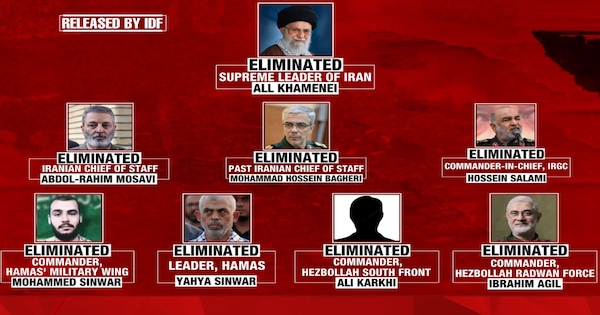
Joint strikes began at approximately 7:00 AM local time across Tehran, Isfahan, Qom, Karaj, and Kermanshah. The opening attack targeted the Leadership House compound, killing Supreme Leader Ali Khamenei. His wife was later confirmed to have died from injuries sustained in the same strike. Ali Shamkhani, former head of the Supreme National Security Council, and numerous other officials were also killed. U.S. officials reported that more than 40 senior Iranian leaders were killed in the opening salvos.
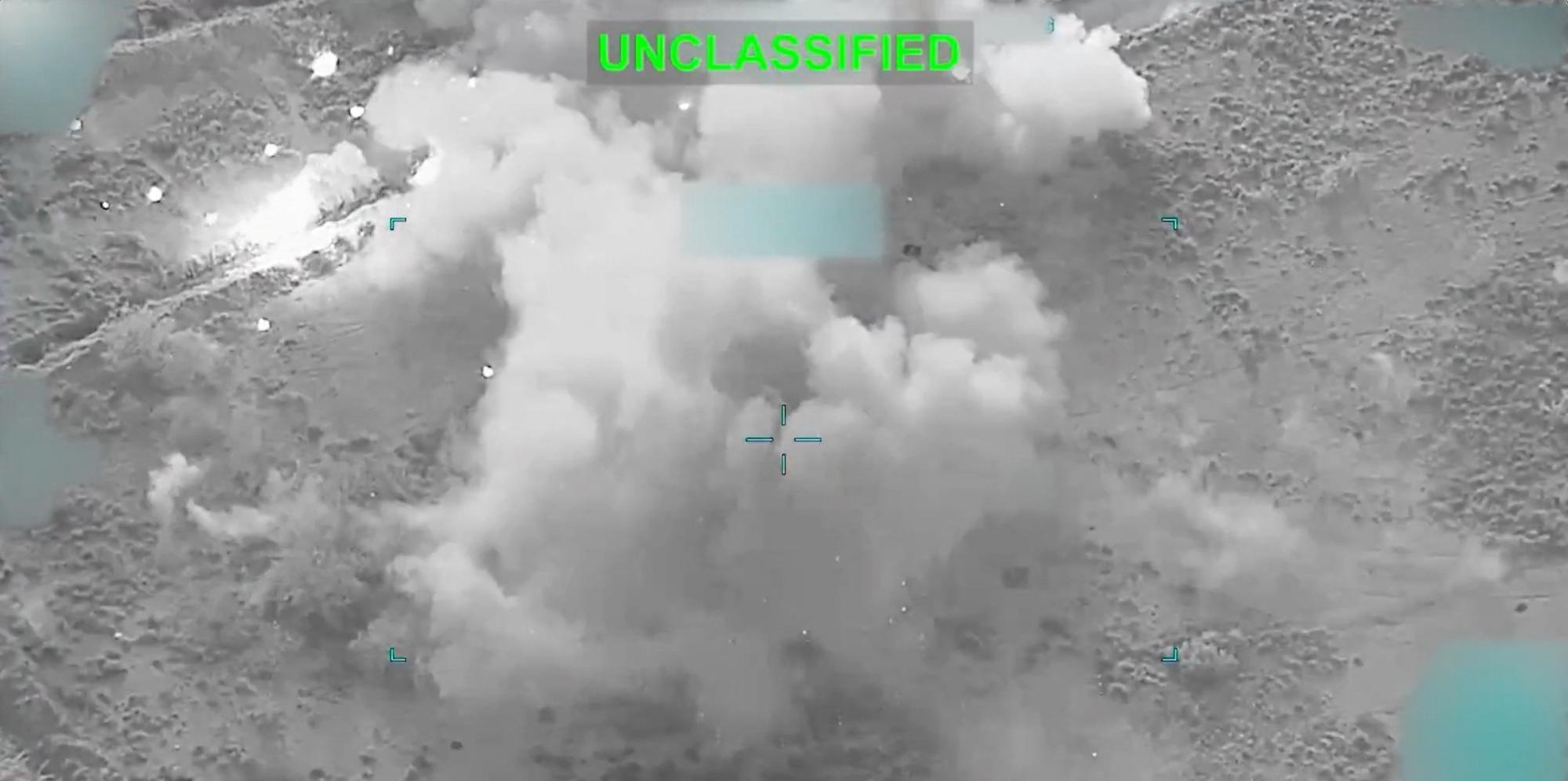
The U.S. and Israel appear to have divided responsibilities based on comparative advantage. Israeli Prime Minister Netanyahu’s address claimed responsibility for leadership decapitation strikes, while Trump’s statement focused on capability degradation, issuing an ultimatum to IRGC personnel to surrender or face destruction. U.S. forces employed B-2 stealth bombers, Tomahawk cruise missiles, and LUCAS attack drones. Joint Chiefs Chairman Gen. Dan Caine described the operation as the culmination of months to years of planning, with final presidential authorisation given on the afternoon of 27 February.
Targets and Effects
Since the opening strikes, the U.S. and Israel have struck more than 2,000 targets across Iran. Key reported targets and effects include:
- Leadership compounds, resulting in the death of the Supreme Leader and over 40 senior government and military officials, creating a succession crisis with competing factions among clerics and the IRGC. Ayatollah Alireza Arafi has reportedly been named acting Supreme Leader.
- Nuclear facilities including the Iran Atomic Energy Agency headquarters in Tehran, the Parchin explosive research facility, and further strikes at the Isfahan nuclear complex. These build on the significant degradation achieved during Operation Midnight Hammer in June 2025, which destroyed enrichment facilities at Fordow and Natanz.
- The IRGC Malek-Ashtar building in Tehran, completely destroyed as confirmed by video footage released by Iran International on 2 March.
- Iran’s national broadcasting headquarters (IRIB) and the Assembly of Experts building, the latter struck while members were meeting to elect a new Supreme Leader.
- Iran’s parliament building, targeted by airstrikes according to Iranian state-linked media.
- Iranian naval forces, with the U.S. confirming all 11 previously active Iranian warships in the Gulf of Oman have been neutralised. The IRIS Jamaran, a Moudge-class light frigate, was among the first vessels sunk.
- Ballistic missile sites and air defence systems, with the U.S. establishing local air superiority according to CENTCOM.
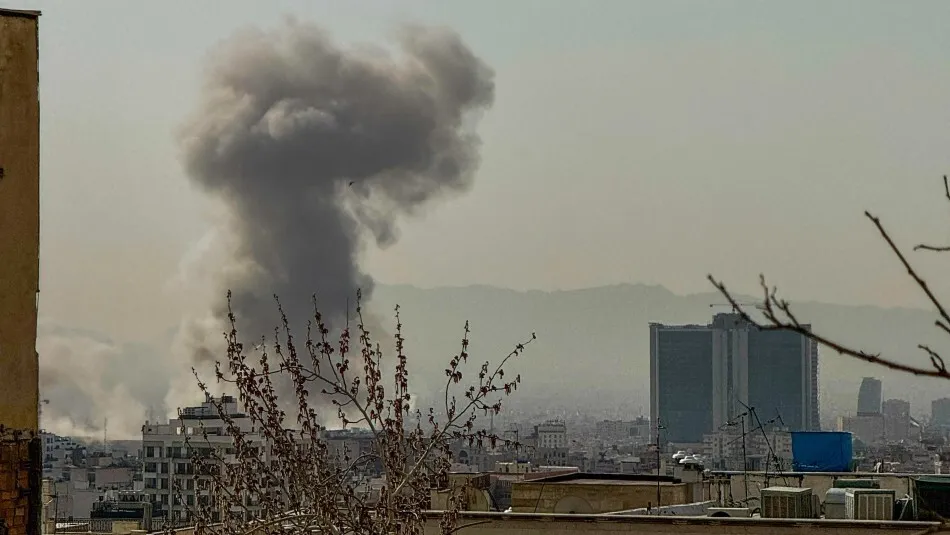
The Bushehr nuclear reactor remains a critical escalatory risk. Rosatom evacuated nearly 100 staff but personnel remain on-site to keep the reactor running. No confirmed strikes have been reported against the reactor, though explosions have been reported in the surrounding port city.
Iranian Retaliation: Operation True Promise IV
Iran’s response was designated Operation True Promise IV. Tehran’s retaliation has been multi-domain, combining kinetic strikes, maritime disruption, proxy activation, and cyber operations.
Kinetic Strikes
Iran launched missile and drone barrages against U.S. forward bases across the Middle East, including Naval Support Activity Bahrain, Al Udeid Air Base in Qatar, Al Dhafra Air Base in the UAE, Ali Al Salem Air Base in Kuwait, and Muwaffaq al-Salti Air Base in Jordan. Satellite imagery and open-source reporting confirmed impacts at multiple installations. Iran also launched approximately 125 missiles toward Israel in the initial retaliatory wave.
Strikes hit civilian infrastructure in Gulf states including Jebel Ali port in Dubai and Camp Arifjan in Kuwait. A Shahed-136 drone struck Saudi Aramco’s Ras Tanura facility, and an AWS data centre in the UAE was impacted, causing significant service disruptions. An Iranian drone also struck RAF Akrotiri in Cyprus, a British overseas territory. Six U.S. service members have been killed in action as of 4 March. Iran’s Foreign Ministry acknowledged the military has lost control over several units, which are operating under old general instructions, suggesting fragmented command and control.
Maritime Disruption: Strait of Hormuz
Within hours of the initial strikes, the IRGC transmitted VHF warnings to vessels in the Strait of Hormuz, stating no ships would be permitted to pass. While Iran has not formally declared a blockade, tanker traffic dropped by approximately 70 per cent almost immediately, with over 150 ships anchoring outside the strait. A senior IRGC adviser subsequently stated the strait was closed, threatening to set ablaze any vessel attempting passage. CENTCOM disputed the closure, but the withdrawal of commercial operators and marine insurers has created a de facto shutdown for most global shipping.
Major shipping companies including Maersk, MSC, Hapag-Lloyd, CMA CGM, and COSCO have suspended operations through the strait. VLCC freight rates from the Middle East to China hit an all-time high of $423,736 per day on 3 March, representing a 94 per cent increase from the previous Friday. Oil prices jumped as much as 13 per cent. Approximately 20 per cent of the world’s daily oil consumption normally transits the strait.
Proxy Activation
Hezbollah launched rockets and drones into Israel on 2 March, targeting an IDF base near Haifa, in retaliation for Khamenei’s killing. The IDF characterised this as an official declaration of war by Hezbollah. Israel responded with naval attacks and airstrikes on targets in Lebanon, which
Lebanese officials said killed 52 people. The Lebanese government, led by Prime Minister Nawaf Salam, moved to ban Hezbollah’s military activities and restrict the group to a political role. In Iraq, pro-Iranian militia groups attacked U.S. bases near Baghdad and Erbil. Houthi threats to resume attacks on shipping in the Red Sea and Bab el-Mandeb Strait have further compounded maritime risk.
Cyber Domain
Iranian internet connectivity dropped to between 1 and 4 per cent by the morning of 28 February, cutting off state-aligned cyber units from their command and control infrastructure. Despite this, Iran-aligned hacktivist activity surged rapidly. A newly formed coordination hub called the Electronic Operations Room was established on 28 February, coordinating groups including Handala Hack (linked to MOIS), Cyber Islamic Resistance, and others. Claimed attacks include compromises of Israeli defence companies, drone defence systems, and payment infrastructure, as well as DDoS attacks on banking and government sites across Bahrain, Saudi Arabia, Jordan, and the UAE.
On the offensive side, Palo Alto Networks’ Unit 42 identified phishing campaigns deploying malicious replicas of Israel’s RedAlert emergency app. Handala Hack escalated from digital disruption to physical intimidation, reportedly sharing home addresses of Iranian-American and Iranian-Canadian influencers with physical operatives. Anti-Iranian groups including Gonjeshke Darande have also been active. U.S. cybersecurity firms assess that Iranian state-sponsored groups, including APT42, APT33, APT34, and MuddyWater, are expected to target critical infrastructure including power grids, water utilities, banking networks, and transportation systems.
International Response
The international response has been mixed. The U.S. strikes received explicit or partial support from Australia, Canada, the United Kingdom, New Zealand, Albania, Argentina, the Czech Republic, and Kosovo, among others. The UK reversed its earlier position and granted permission for the U.S. to use British bases for defensive support, opening RAF Fairford and Diego Garcia. British jets are now operating within the conflict zone. The UK also disclosed that Ukrainian counter-UAS specialists would assist Gulf states against Iranian drone strikes. France deployed the aircraft carrier Charles de Gaulle to the Mediterranean.
New Zealand acknowledged the strikes were designed to prevent Iran from threatening international peace and security, while condemning Iran’s retaliatory attacks on Gulf states. China called for an immediate halt to military actions. Russia called the strikes an unprovoked act of aggression. The UN Secretary General condemned the use of force. Saudi Arabia and the UAE, initially committed only to intercepting salvos, signalled willingness to respond directly after Iranian strikes caused civilian casualties on their territory. A joint statement by the UAE, Qatar, Saudi Arabia, Bahrain, Jordan, Kuwait, and the U.S. condemned Iran’s indiscriminate attacks. Turkey called the strikes a clear violation of international law.
Ukraine endorsed the operation, with President Zelensky noting Iran’s role as an accomplice to Russia and supplier of Shahed drones that have struck Ukrainian cities more than 57,000 times.
Civilian casualties have been significant. The Iranian Red Crescent reported over 600 civilian deaths by 3 March. A missile strike on a girls’ school in Minab reportedly killed more than 160 students. Hospitals in Tehran, including Khatam-al-Anbia and Gandhi hospitals, were hit by strikes as reported by Iran and verified by BBC Verify.
Why This Matters
Operation Epic Fury represents a qualitative escalation beyond counterproliferation. The combination of leadership decapitation, regime change objectives, and systematic capability degradation constitutes the opening phase of what officials have characterised as a prolonged campaign. Several dynamics make this conflict particularly consequential.
Succession crisis and command fragmentation. The killing of Khamenei and more than 40 senior officials has created a power vacuum. The IRGC and clerical establishment are competing for control. Iran’s Foreign Ministry has acknowledged that some military units are operating autonomously under old instructions, raising the risk of unpredictable and decentralised retaliation. This fragmentation complicates deterrence calculations significantly. Centralised command may not be the primary driver of Iranian actions in the weeks ahead. Instead, semi-autonomous networks and ideologically motivated actors may mobilise independently in response to symbolic triggers such as leadership decapitation.
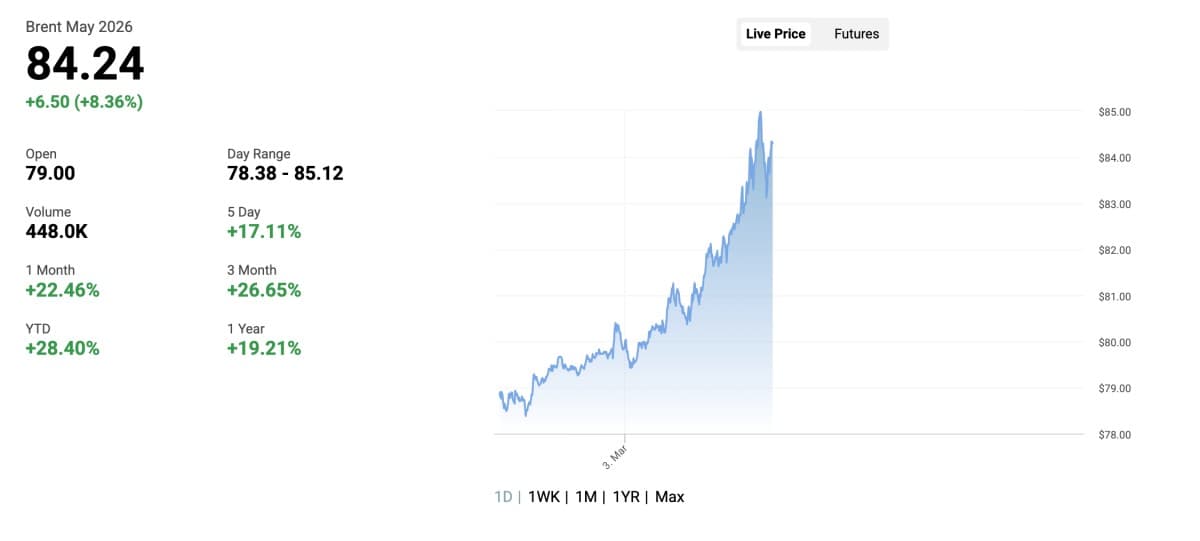
Global energy disruption. The effective closure of the Strait of Hormuz threatens approximately 20 per cent of global oil supply. The withdrawal of insurance coverage has achieved what a formal blockade has not. Alternative pipeline routes through Saudi Arabia and the UAE can only accommodate a fraction of normal volumes. If the disruption extends for weeks, oil prices could reach triple digits, with severe consequences for inflation and global economic stability. Asian markets, particularly China, India, Japan, and South Korea, are disproportionately exposed.
Multi-front escalation. What began as a focused strike has expanded to involve at least eight countries through Iranian retaliatory action, a renewed Hezbollah front in Lebanon, and Houthi threats in the Red Sea. The E3 nations have signalled willingness to support proportionate defensive measures. NATO has heightened its missile defence posture. The Iran-China-Russia trilateral strategic pact signed on 29 January 2026 provides diplomatic cover, intelligence cooperation, and possibly satellite imagery to Iran, though it does not constitute a mutual defence treaty.
Cyber escalation. The conflict has generated one of the most intense cyber confrontations in recent memory. Iranian threat actors have historically shifted from espionage to destructive and retaliatory attacks during geopolitical escalation. The combination of wiper malware, DDoS campaigns, infrastructure targeting, and disinformation operations creates a persistent threat to critical infrastructure across the U.S., Israel, and allied nations. The move from digital disruption to physical intimidation by groups like Handala Hack represents a dangerous new precedent.
Civilian impact. Reported civilian casualties in Iran, including the Minab school strike, are generating significant international attention. Strikes on hospitals and civilian infrastructure have been verified by independent monitoring. These dynamics are shaping international opinion and may constrain coalition support over time.
What’s Next
President Trump has characterised this as a four-to-five-week campaign. Secretary of War Hegseth has stated the operation is not intended to be open-ended but has declined to rule out boots on the ground. The U.S. continues to project force into the region, with the USS Abraham Lincoln and USS Gerald R. Ford carrier strike groups operational in the theatre, along with additional capabilities flowing in.
Iran has signalled both defiance and willingness to negotiate. Ali Larijani ruled out talks on 3 March, stating Iran has prepared for a long war. However, Iran has also passed messages to Gulf states indicating openness to de-escalation. The gap between these positions may reflect internal fragmentation rather than a coherent strategy.
The most likely near-term trajectories include continued U.S.-Israeli airstrikes targeting remaining military infrastructure and missile sites, sustained Iranian retaliation through dispersed kinetic strikes and proxy operations, an intensified cyber campaign against Western and allied critical infrastructure, and ongoing maritime disruption in the Strait of Hormuz and potentially the Bab el-Mandeb. The Israel-Lebanon front may expand depending on Hezbollah’s calculations, which are shaped by the organisation’s degraded military capacity after two years of Israeli operations and the existential threat posed by the potential collapse of its Iranian patron.
Indicators to Watch
- Evidence of Iranian command and control reconstitution or further fragmentation, particularly IRGC operational independence from the clerical establishment.
- Escalation or de-escalation signals from Iran’s acting leadership, including any formal proposals for ceasefire or negotiation.
- Hezbollah operational tempo in Lebanon and decisions by Hezbollah leadership to sustain, escalate, or limit military engagement given the risk of an overwhelming Israeli response.
- Houthi activity in the Red Sea and Bab el-Mandeb Strait, particularly resumption of anti-shipping operations.
- Maritime conditions in the Strait of Hormuz, including insurance market decisions, IRGC harassment patterns, and CENTCOM freedom-of-navigation operations.
- Iranian cyber operations targeting Western critical infrastructure, particularly wiper malware deployment, SCADA/ICS targeting, and phishing campaigns by APT42/APT33/MuddyWater.
- Third-party involvement, including any change in China’s or Russia’s posture beyond diplomatic support, particularly intelligence sharing or military material support to Iran.
- Civilian casualty reporting and its effect on coalition cohesion and international political support for the campaign.
- Oil price movements and OPEC+ spare capacity decisions, particularly whether Saudi Arabia and the UAE can offset lost Hormuz throughput via pipeline alternatives.
- Domestic political dynamics within Iran, including regime stability, protest activity, and IRGC-clerical power struggles.

Responses